Tiriki Onus, 'Generational Guests'

Tiriki Onus, 'Generational Guests'
“A souvenir business selling Aboriginal boomerangs and other paraphernalia in the 1950s may seem like a strange place to launch political campaigns from, but it was the work of artists like my grandfather Bill Onus and others that humanised Aboriginal people within a broader Australian consciousness, which helped create bridges that allowed Australia to engage from a place of strength with Aboriginal and Torres Strait Islander culture.”
– Tiriki Onus, Generational Guests, 2023
From 1952 to around 1968, 63 Monbulk Road, Belgrave, was the site of Aboriginal Enterprises, an Aboriginal souvenir shop and factory owned and run by Yorta Yorta activist and artist William ‘Bill’ Onus. This shop became internationally renowned for its designs and artefacts and as a tourist attraction. But importantly, it was also a cultural hub for Aboriginal people and a meeting point for Black civil rights activists.
IMAGE:
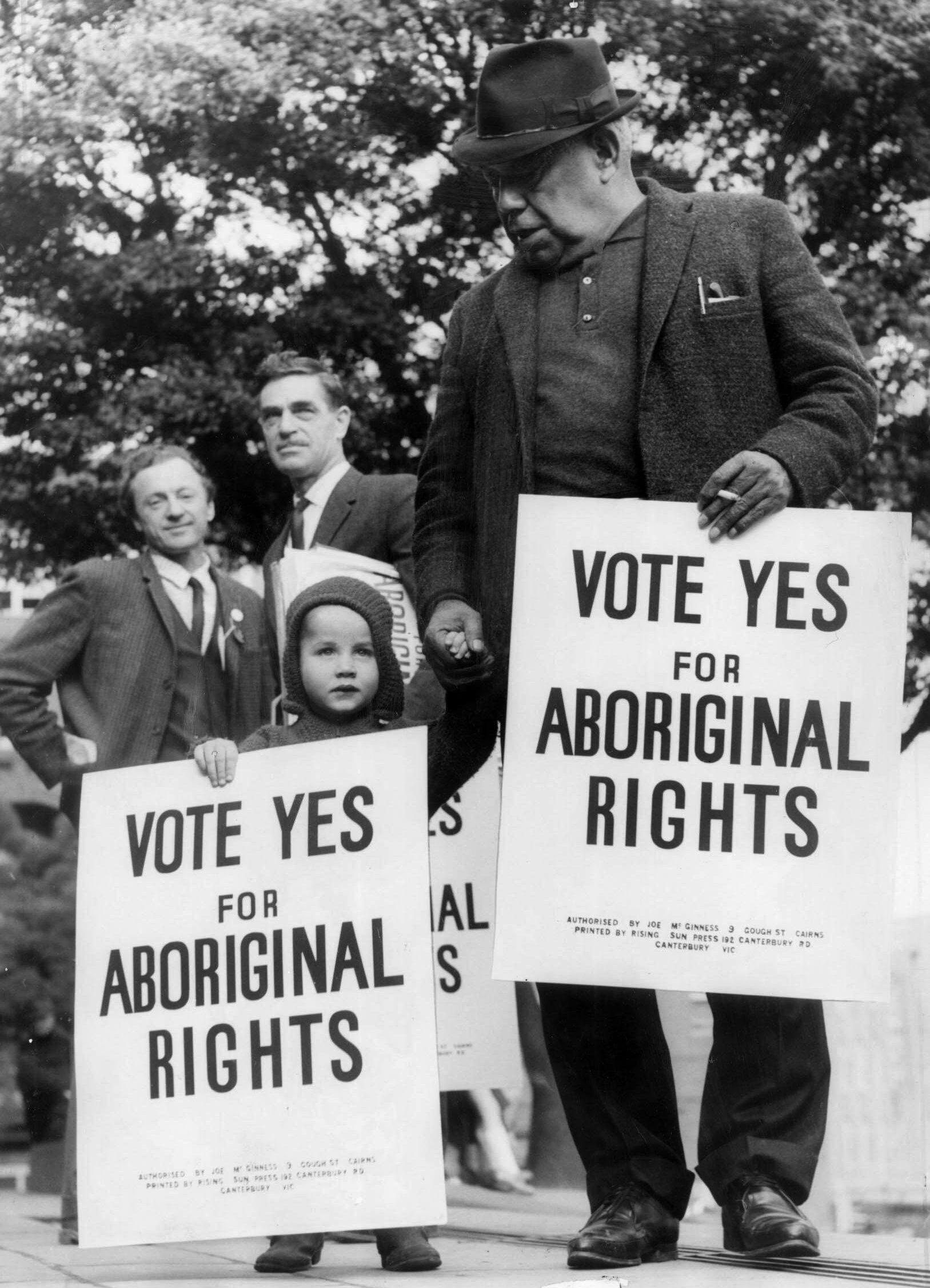
Bill Onus, President of the Victorian Aborigines’ Advancement League, participating as the only Aboriginal person in the march for Aboriginal Rights referendum on May 29, 1967
Source: Fairfax Media
Generational Guests
Growing up, I used to hear so many stories about this place. Stories about how it shaped and changed so much of our society, so much of our communities. How this place had largely been responsible for the stories in my family persisting: this little shop just outside Belgrave, a tiny little fibro shack that figured so large in my own history and identity, one that I’ve only been inside a couple of times, but one which almost seemed incapable of containing and holding all the stories that I was told came out of it. My name is Tiriki Onus. I’m a Yorta Yorta and Dja Dja Wurrung artist, academic and maker.
I have the great honour in this space of being a custodian for the stories of my family, my family’s stories here on this Country, which is not ours. Yet, through the love and the diplomacy that have been shown to us by those who speak for this place, we’ve managed to contribute our stories here and the stories of my family and my community, are not just those of resilience or strength, they’re not stories of survival, they are stories of thrivance. I feel quite humbled to be part of this story. I feel quite humbled to know that I walk in the footsteps of extraordinary women, extraordinary men, extraordinary people who have gone before me in this place. That here on this Country for thousands and thousands of generations, artists have told their stories, have danced their dances of sung their songs, have poured them their very selves into this Country, and I consider myself incredibly fortunate to still be reaping the benefits of their work and their sacrifice, even now.
This little shed on the road outside of Belgrave, well, I call it a shed now. It was once upon a time, one of the only buildings here, but this building, this shop, as it still is now, was the site of my grandfather Bill Onus’s first major business venture. Aboriginal Enterprises stood here for a great number of years within the same walls that still stand here now. It wasn’t Bill’s first shop. That one came at Koala Park, north of Sydney. It wasn’t his only shop. After establishing Aboriginal Enterprises here, he set up branches at Narbethong and all the way over in Port Augusta. But this shop here, this place here in the Dandenongs, for me, it’s still the heart of this story, a story that so many people own. It doesn’t just belong to me. In fact, whenever I go out into communities, whenever people hear the name, Bill Onus, invariably someone wants to pull me aside and tell me the stories that they have of the shop.
It was in this shop here that my mother, along with her parents, met my grandfather for the first time. She was all of three or four years old, but out he came from behind the counter and squatted down to speak to her, as her mother and father said, now you speak to Mr. Onus, my grandfather Bill, never knowing that that tiny little shy girl was one day going to grow up, marry his son, and ultimately have me. There’s deep stories here for my family. But there are deep stories for so many people here, and around these hills, in these trees, in these waters.
The story of strength, resilience, and thrivance that has been part of this Country for thousands of generations didn’t stop two and a half centuries ago, it has been added to. And I’m incredibly grateful for those who have held space here, not just here in this little shop, but here, in this Country. Because this shop became something of a melting pot. And for some reason, these hills have kept and held my family close. As I say, it’s not our Country, but we’ve always, always been drawn back here. Bill’s first little shop, positioned as it was to be on the tourist route between Healesville Sanctuary, William Rickett Sanctuary and Puffing Billy, was always intended as a place of confluence, of flux, where stories would come together and where the story of the strength and the vitality of Aboriginal Australia could be shared with the world. See Bill, my grandfather, had worked for many, many years as an activist. He’d set up organisations. He travelled around the country and had attempted to travel around the world to tell these stories, but his worldly travels were often cut short by the intelligence service of the day, scared of what he might do if he actually got out and got the opportunity to tell people outside of Australia what was going on inside.
But if he couldn’t make it to the world, he resolved that he was going to bring the world to him. In the early 1950s after having a car accident—after being, as my father once colourfully put it, ‘snotted’ by a fire engine—as Bill was driving, he was paid compensation money, almost unheard of for an Aboriginal person in the 1950s, but he was. And with that compensation money, he didn’t do anything sensible, like buy food for his family or pay off the mortgage or something like that. No, he bought a shop up here in Belgrave. A shop from which he wanted to sell, not just items of significant cultural and aesthetic value, but to sell ideas. This little shop became a place where movie stars and famous musicians, where great activists, would come congregate, where stories would indeed be told. As I was told those stories growing up, I was shown old home movie footage of people like famous Calypso singer Harry Belafonte, learning to throw boomerangs out the front, in front of The Red Mill. As the camera pans across you see great activists of the day like Pastor Doug Nicholls and Aunty Gladys; here all the women dressed in furs, the men in suits. This is clearly a significant occasion, but it is an occasion which connects not just black activists from across oceans, but it connects creatives together, and that has been so much of the power of this place. ‘The Hills’ is a place that my family has come to make art for all this time.
A souvenir business selling Aboriginal boomerangs and other paraphernalia in the 1950s may seem like a strange place to launch political campaigns from, but it was the work of artists like Bill and others, making boomerangs in little corrugated iron shacks beside the road or selling their work out of the boots of cars, that humanised Aboriginal people within a broader Australian consciousness, which helped create bridges that allowed Australia to engage from a place of strength with Aboriginal and Torres Strait Islander culture. This was the birth of the Aboriginal art market, now responsible for billions of dollars a year, and in these early days, it is entirely held by Aboriginal people.
The artworks that were sold to the shop were made out the back in what was called ‘the factory’. But not just that, they came from out on Country. Objects were brought in. Sometimes objects were smuggled in, smuggled out the back of mission stations: culture and knowledge, commodified for the strength and wellbeing of families at a time when people’s lives are still highly controlled, when they’re kept within the boundaries of missions and government stations. Art and creative practice offer, not just a cultural and spiritual outlet, but a real meaningful, tangible financial. It is extraordinary how far these stories travel. Because it’s not just about where they come to here in the Dandenongs, it’s where they go to, beyond here. That has been so much the story of strength, the types of people that have come through here—extraordinary artists like the great Aboriginal opera singer, Harold Blair, who, when he was blacklisted by the ABC, instead took to working with my grandfather Bill, would drive all the way from the Belgrave shop to Narbethong, all the way out to Port Augusta and back again, delivering stock between the shops, promoting everything that they were trying to do here at Aboriginal Enterprises.
My father Lin would often tell fond stories of sitting there in the car with Uncle Harold as Harold drove along, Harold singing beautiful Lieder and arias from his many and varied performances. And my father Lin, as a sullen teenager sitting there to himself thinking, oh, ‘go on Uncle Harold can we not just have the radio?’ Never quite realising how incredibly fortunate and blessed he was, until many years later. Harold Blair wasn’t the only one. Harry Williams came through here. Indeed Harry Williams, the great country and western singer, one of our first mainstream stars along with his wife Wilga, worked at the shop here with Bill. Harry would have to dress up as Santa every year for the Christmas party when all of the families and all of the kids were brought around, because Bill had decided that Harry was the darkest and Bill wanted the blackest Santa he could possibly have. Never mind that Bill was probably the largest, but no, Harry Williams was Santa. And indeed, even after Bill’s passing, Harry went on to continue the souvenir business alongside my father, Lin Onus and my mother Jo. The stories of these places don’t belong to just one person. The are intergenerational. They belong to so many of us. Great artists like Revel Cooper continued their practice here after coming over from Carrolup in Western Australia. Extraordinary artists have plied their trade and told their stories and, perhaps most excitingly in one way, they weren’t just Aboriginal artists here.
Indeed, here in the Dandenongs in the 1950s in Australia, there was a handful of white Australian people, I would imagine the only ones in the country at this stage, who could turn around and say that they were in the employ of an Aboriginal person. Bill saw past the barriers and false obstructions that are created on the basis of ethnicity, and instead, was committed to positioning an authority of Indigenous voice at the forefront of everything that they did, and then supporting and assisting non-Indigenous colleagues, friends, and allies to mobilise their privileges within this space and to make something together. The work that they did for Bill was not one of appropriation or extraction. They worked very clearly to his direction, to his rule, under his guidance. They were part of this space, part of a safe space that had been created for Aboriginal and Torres Strait Islander people and for broader communities to engage. Where the authority of Aboriginal people was paramount and where an understanding of the deep and meaningful connection to place and to Country was still manifest.
That’s the magic part of this story. It feels like Bill and many of those people in the shop managed to skip a whole bunch of steps in there somehow and start dreaming about a society that they wanted to see and, instead of just theorising, would do it. Designers like Paula Kerry working so very closely with Bill to refine his designs, his works, so they weren’t just sold in the souvenir context, but rather they started to change the shape of our communities around us. Because it wasn’t just about artworks. So much of what happened here in the shop and in this place was about performative outcomes as well. Performative outcomes of culture and practice, performative outcomes which shaped and were shared with the broader society. Before opening the shop, Bill had already come from a tradition of performance. Upon escaping the missions when he was young, he’d grown up with his parents, his brother and sister, in a covered wagon, droving cattle throughout the Riverina. After that, he joined the travelling shows. He learned to throw the boomerang, to play the gum leaf, to eat fire, to box. He knew about the power of performance, the power of the stage, and the power of being able to stand there in front of an audience. The way you held them, the way you could speak your mind, the opportunity to put an agenda forwards, and so much of that happened here as well. There was the performative aspect of him stopping traffic along the road to throw boomerangs for all who would come. There was also the connection that he made with performers, the way Bill, and others from the shop here, engaged with communities far and wide to tell our stories. In the 1950s, it was still largely illegal for Aboriginal people to speak our language, to dance our dances, to sing our songs, to practice our culture in any fashion.
But if you put it on a stage, if you put it on a stage for the world to see, you could hide in plain sight. And that’s what so many of the people who were here were doing as well, performative resistance and activism that the whole of Australia was being exposed to and which so few people actually understood the significance and meaning of, but which they appreciated nonetheless. These are the extraordinary stories of strength that come out of places like this little shop; that spread like ripples on the surface of a pond. They have such impact, such strength and such importance.
I’m incredibly grateful and honoured to be part of it and who have been told these stories again and again throughout my life. Recently, sitting across opposite from the late, great, legendary national treasure Jack Charles, as Uncle Jack talked to me about an excursion—an excursion up to the Hills when he was just a boy, still living in and out of foster homes and boys’ homes—climbing off a bus at the end and seeing this extraordinary sight of a big, smiling black man with boomerangs in his hands. He’d been taken to Bill’s shop. He was the only Aboriginal kid in the group, and Bill made a beeline for him bending down and speaking to him, showing him the boomerangs, showing all of the children the ways in which he enacted culture on a day-to-day basis, and the way in which everyone around them did as well. But not just the shop, but this strip of road out the front is a scene of some of the most important cultural maintenance and resistance that has gone on in my family and indeed a few others over this time as well. The way a legend like Uncle Jack would light up in his eyes and talk about the impact that was made upon him by seeing the strength of Aboriginal people after having spent so much of his life being engaged with in terms of deficit and loss. It’s extraordinary and inspiring for me to still hear these stories now. That when people tell us these stories, when they share, it’s a gift and you can see the significance, the weight of that gift as they hand it to you. The shop is significant, but it’s not the only side of significance for me and my family, but it’s because of it that so much else happens here.
Just up the road from here in the 1970s, after the passing of my grandfather Bill, my father Lin stages the first ever forced land rights claim in this area. In the 1970s, he builds a roundhouse, a log cabin roundhouse, just down off the side of the road. Growing up, there was always an overgrown tree stump that we would drive past, and I would be told every time, I’m on the way to my grandmother’s house every time, that’s where the land claim was. That stump’s gone now, but I still have a reasonably shrewd idea of where it was.
It forms part of these mythologies that we share and share again, the significance of a land claim, of a forced land rights claim where Aboriginal people stood up and said, ‘This is ours. We’re taking it.’’ Lin was very conscious that this wasn’t his traditional Country. In these days, in these early days in the 1970s, we were less aware of where our individual Countries were, where our borders were. But he named this claim for a group of the Kulin at least, the Bunurong land rights claim. Indeed, a lot of his early research had led him to the understanding that this was Bunurong Country here. And as his understanding grew in later years and changed, the complexity of what it means to be here on Country was brought home again and again; that names may not be entirely sufficient, but they embody the spirit of the stories and the layering that has gone on for thousands and thousands of generations. And the stories of that land claim, still get and reverentially passed to me as well. Stories of young boys being made to climb trees to hang the protest banners, falling out of said trees and, just before they’re about to hit the ground, thinking that they’ll be caught, watching my father leap like a gazelle to one side. They’re stories of strength, they are stories that we have a need, I feel, to tell on again and again.
Even after the Bunurong Land Rights Claim, the Hills kept being a place that we were drawn to. When my father met my mother Jo, a few years after the land claim was burnt to the ground by neo-Nazis in the middle of the night, a few years after that, when he met my mother, they too came back here. They had a little shop in the main street of Upwey where once again they opened up a factory, as they called it, and started making boomerangs, objects of cultural significance. They went from there with Harry and Wilga Williams to open a shop out at Bacchus Marsh Lion Park. But again, it was to here that we always returned. And it seemed fitting I think, to my father Lin, that ultimately when it came time for him to properly establish himself as an artist with a studio and a making practices, that it would happen here, in the Hills, beneath the shadow of goranwarrabil. This is where he would make his art. Art, which would go out to the entire world, but which was still so deeply rooted here in place. So, many of the stories that he wanted to tell came from that little shop, and certainly an understanding. And this was the important thing about the stories that were told me, an understanding of the lineage of these stories. The fact that they don’t die, they don’t go away. They merely change and are added to, just as we add to the stories of this Country now, those of us who walk upon it, that long before this Wurundjeri woiwurrung people made their stories here, and welcomed others onto this Country, that those stories did not go away. Rather, we continue to add in this place, and the privilege that I feel at being able to tell my stories here now is only because of the love, generosity, diplomacy and care that has been shown me by those who speak for this place. It is an extraordinary gift, an extraordinary joy to be here to tell these stories and to know that they will be told again and again.
And to know that they don’t belong to me. These stories are too big to belong to me. They belong to all those who find themselves drawn. So, if there is more of this story that you want to know, if there is more of this story that you hold, please hold it, tell it, celebrate it. Because I don’t get any weaker by these stories told, I only get stronger. It does more of the work for my kids, for my family, and I’m very excited to think of the lineage of practice that has gone on here in this place, unbroken. That not just I hope to contribute to, but which I see my children, my grandchildren, all those who come after, continuing to contribute to and build here in this place. It’s an honour to do this work here and to celebrate these incredibly important, these sacred spaces to us. Even if they are just little fibro huts at the side of the road, the stories that they embody are incredibly powerful.